
Hey squares! Let's get DOWN with The Kidz!
"Amelia", and the eternal problem of the State trying to be “down with the kidz” as the latest attempt to 'nudge' teenagers just backfired spectacularly.

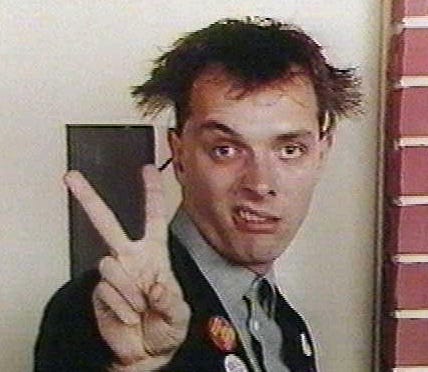
The late, great Rik Mayall as Rik, the activist student from the Young Ones ruthlessly parodied State attempts to be relevant to “The Kidz”.
There are few sights more reliably embarrassing than the British State attempting to “reach” teenagers.
Not teach them, mind you. Not speak plainly to them, adult-to-almost-adult. Not even argue with them. No: reach them. Get a bit relatable. Put the message in a hoodie. Toss in some slang last used by sometime around the first iPhone. Then act shocked…nay.. shocked!… when the intended audience reacts with the one weapon teenagers have always wielded better than any other demographic in history: contempt.
The 1980s gave us a masterclass in this. “Just Say No” arrived from America like a plastic toy in a cereal box: shiny, simple, and instantly discarded. Grange Hill’s famous “Kidz” anti-drugs storyline tried to package morality as a youth movement. It produced a lot of worthy television and a great deal of unintentional comedy because the moment adults try to write “teen rebellion” on the page, it reads like an HR memo with trainers on.
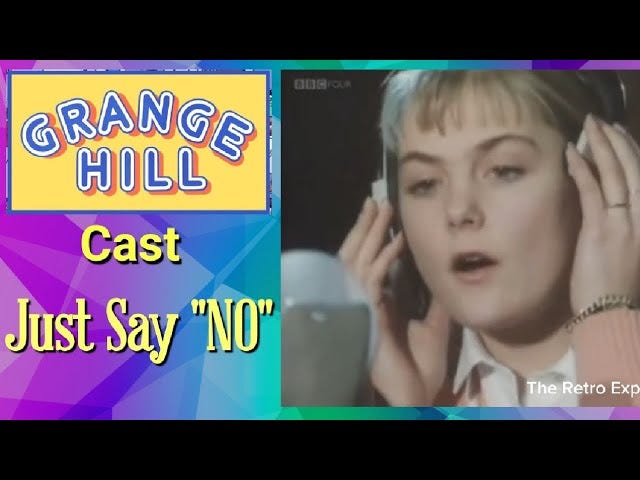
I was a teenager in the 1980s when the BBC decided to use the poor cast of Grange Hill to promote the Nancy Reagan ‘Just say “NO”’ campaign - a worthy attempt to educated teenagers that they could resist peer pressure around drugs, landed like a wet squib as teenagers across Blighty winced at the CRINGE..
And then you had Rik Mayall, God rest him, and The Young Ones, which didn’t merely mock the youth-campaign aesthetic; it vivisected it. The show understood what the Home Office still doesn’t: teenagers can smell patronising propaganda the way sharks smell blood. They don’t need to be told it’s propaganda. They don’t need it labelled. They can taste it. And once they taste it, they don’t debate it, they ridicule it.
Which brings us to the “Amelia” phenomenon. The latest ham-fisted attemtp to ‘deradicalise the KIDZ’ is Pathways, an interactive “learning package” produced by Shout Out UK and promoted through local authority / Prevent-linked channels, aimed at teaching children aged roughly 11–18 about “extremism”, “radicalisation”, and the Prevent programme. (Shout Out UK)
What does the game actually do?
To understand why “Amelia” became a meme, you have to grasp the basic mechanics of the thing. Pathways is presented as a “youth-centred interactive learning package” about extremism, radicalisation, and Prevent, a choose-your-own-adventure visual novel aimed at 11–18 year-olds.
You play as “Charlie” (male or female), a white British teenager navigating a handful of set-piece “scenarios” about online content and political views. Commentators who played it through describe six scenes, but the one that matters for our purposes is the “jobs/grades/immigration” pathway that tees up Amelia.
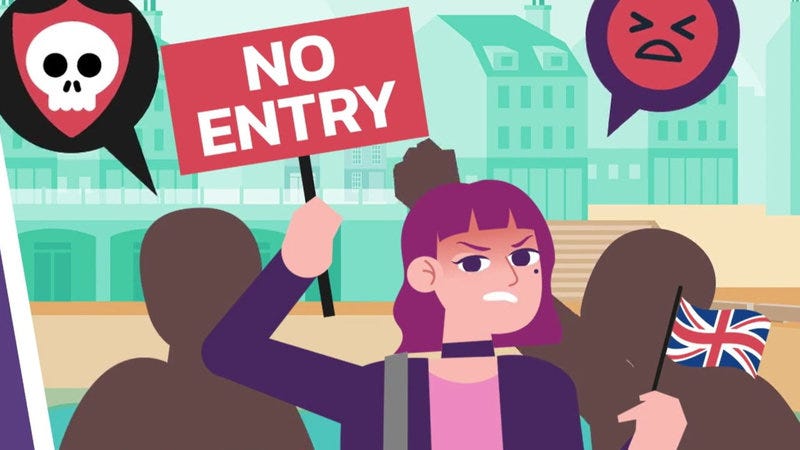
“Pathways” presents ‘Amelia’ as the antagonist: a purple haired goth vibe girl who ‘radicalises’ ‘Charlie’ with ‘far right’ views (i.e. widely held concern about the consequences of mass immigration)
In that scenario, Charlie is taking a test connected to getting a job. A “brown-skinned” classmate scores higher; a white classmate then frames this as evidence that immigrants are “taking white jobs”. The player can (a) go to the teacher for help, (b) stay silent, or (c) “agree and explore the idea further”. According to the playthrough summary, agreeing is treated as a negative step but so is staying quiet, because Charlie later “thinks about it” and drifts toward agreement anyway.
And then, crucially, the girl from that thread reappears as Amelia: purple-haired, goth-coded, and positioned as the “radicalising” influence in the immigration scenario: she invites Charlie into encrypted groups, nudges them toward protests, and generally functions as the game’s big red warning label for “far-Right” online influence.
Now pause and admire the conceptual own goal.
In the mind of the project’s authors, a teenager experiencing resentment about grades, jobs, and perceived unfairness, and then talking to someone who introduces immigration arguments, is not “a politically normal adolescent trying to make sense of the world.” It’s a Prevent pathway. The mere act of engaging with claims about mass immigration, demographic change, jobs, and “British values” is framed as the slippery slope to radicalisation.
Then, to compound the ham-fisted analysis, they wrap it in a “game” whose tone many players have mocked as infantile, the sort of earnest, simplified, primary-school moralising that makes any half-healthy teenager want to do the opposite purely on principle.
And from that brew, preachiness, ideological certainty, and an aesthetic catastrophe, Amelia is born.
Hull City Council has described it as a bespoke computer game for young people in the city, designed to teach the “dangers of extremism and radicalisation.” (Hull CC News) The teacher guidance for the package explicitly frames it as part of Prevent, funded by the Home Office, delivered with council partners. (Shout Out UK)
So far, so very modern Britain: a bureaucracy with a budget line and a moral panic.
The twist is that “Amelia”, framed by the game as a nationalist / anti-immigration influence, has been seized upon by The Kidz as an icon. Not because teenagers are all “far right”. But because the presentation is so clumsy, so preachy, so on-the-nose, that it triggers the oldest reflex in youth culture: contrarianism for sport.(UnHerd) Never mind the fact that Amelia seems to make some very valid points about the impact of mass demographic change through unprecedented immigration numbers. The authors of the game, of course, being activists, see merely stating the facts around the impact of mass immigration as radicalisation, therefore Amelia is the evil far right antagonist… for effectively spelling out a few unpleasant home truths. Of course, teenagers being teenagers smell this a mile away and so the State designed a villain which they have now adopted as a mascot.
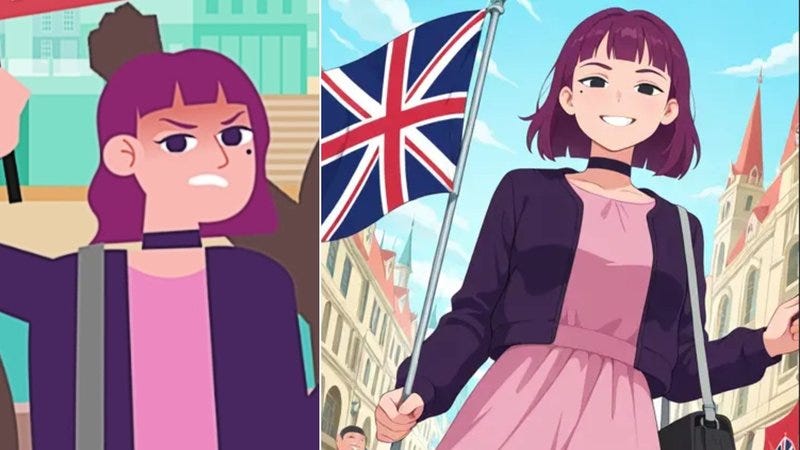
One of the many Memes of the last week. Left - Amelia as “Pathways” presents her… Right - Amelia as the audience have adopted her. Teenagers smell performative bullshit a mile away.
And the bureaucrats are staring at their screens bamboozled by the response, like Victorian clergymen discovering progressive jazz.
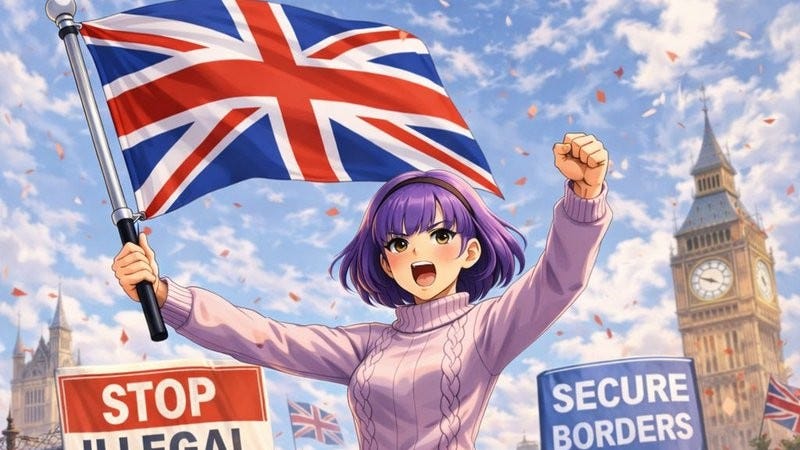
‘Amelia’ has become a new Britannia for a generation which can smell bullshit propaganda quicker than a shark smells blood in the water. The developers of the game have compounded their misunderstanding of teenage culture by not only patronising them with this cringe, but by revealing their own political bias - that legitimate criticism of mass immigration policy, is ‘far right’ and unacceptable.

The cringe has backfired so spectacularly that it has gone viral around the world. Amelia has been elevated to a new Britannia, not only by British teens, but by internet culture across the world. The helmet replaced by a purple bob, the trident by a Union Flag, in meme terms, she is Britannia for the age.
The deradicalisation industry’s fatal misunderstanding of teenagers
Now I am the parent of teenagers and here is the rule: older than punk, older than Teddy Boys, older than the first boy to roll his eyes at a headmaster:
If you want teenagers to do something, you do not attempt to mimic their culture.
You can’t. You won’t. It will be cringe. And cringe is death.
Teenagers are not merely people with fewer years. They are people in a culture with its own ruthless immune system. It detects adult performance instantly. The more you try to be “relatable”, the more you advertise that you are not. And once you’ve been filed under trying too hard, you’re finished.
But you can always rely on the State to ignore turisms as old as the hills, so convinced are they that they know best. So what did they do:
they hired activists and “engagement professionals” who are very good at pleasing each other, very good at speaking the dialect of funding bids, and catastrophically bad at understanding boys who spend their evenings in group chats saying things they would never say in public. It gives those professionals a moral mission (“deradicalise the far right”), and it encourages them to treat ordinary teenage scepticism; particularly about immigration, censorship, policing, and national identity; as a pathology to be corrected.
And then, with straight faces, it turns that mission into a patronising and basic game with all the aesthetics of made for a pre-school market yet presented to a teen audience by Shout Out UK with all the self awareness of a middle aged dad dancing at a wedding.
This is the part where you have to ask: have the people who designed this ever met teenagers? Are they parents of teens? Have they stood in a kitchen doorway and watched a 15-year-old annihilate a sanctimonious adult argument with a single eyebrow raise and a muttered “sure mate”?
Because this is what happens when you build a “youth-centred” propaganda product: it leaks out of the intended classroom setting, gets played by adults online, and becomes a national joke. (UnHerd)
Worse than a joke: it becomes a recruiting poster for the very attitudes it claims to combat: in this case emphasising to the audience that the State considers their concerns as beneath contempt.
Why it backfired so spectacularly
The Amelia meme isn’t merely people being silly on the internet. It’s a signal flare, telling you something uncomfortable about the political class.
The backfire comes from three collisions:
First collision: moral certainty meets adolescent rebellion.
Teenagers are wired to test boundaries. It is how they become adults. If you tell them “this opinion is forbidden”, many will touch it simply to see what happens, especially boys, who are allergic to being told what to think by people they do not respect.
Second collision: propaganda meets aesthetic.
The modern State is uniquely incapable of understanding aesthetic power. It believes politics is a set of correct opinions. Teenagers understand that politics is also identity, tribe, and vibe. If you design a character with distinctive style and then announce “this is the bad one”, you are essentially hanging a neon sign saying adopt this to annoy your teachers and parents. (Know Your Meme)
Third collision: adult fear of “wrongthink” meets teenage hatred of being patronised.
The game reportedly nudges players toward reporting or avoiding certain views as “extreme right-wing ideology”, including opinions around immigration that are widely held outside the NGO bubble. (The Spectator Australia) But that are considered beyond the pale by the twatterati class.
That’s the moment the whole thing stops being “safeguarding” and starts feeling like ideological policing and, teenagers, whatever else they are, are not sentimental about authority.
So instead of “deradicalising”, it performs the opposite: it teaches a generation that the State equates political disagreement with extremism, and that the proper response is either silence or mockery.
They choose mockery. Of course they do.
The ancient lesson the British establishment refuses to learn.
Here is the bitter truth: teenagers do not need the State to create a playable morality tale in order to understand that violence is wrong. What they need, what we all needed, is something infinitely more boring and infinitely more effective:
Adults who model adulthood. Speak plainly. No slang. No cosplay. No “Hey Kidz!” cringe.
Civic education that doesn’t treat disagreement as sickness. Teach argument. Teach critical thinking. Teach how to test claims. Teach how to spot manipulation, including your own. Stop telling young people what to think and start teaching them how to think.
A culture of responsibility. If you’re worried about genuine extremism, stop outsourcing parenting to a “programme”. Strengthen families, schools, and communities. The State is a clumsy substitute for all three.
Because when the State tries to parent teenagers, it doesn’t produce virtue. It produces the very thing it claims to oppose: alienation, suspicion, and the sense that the adults running the country are unserious people playing dress-up with power.
And when that happens, “Amelia” is what you get: a meme born from bureaucratic arrogance and a reminder that you cannot admin your way to cultural authority.
I edit these on the hoof so if you spot any bo boos please let me know.
This is an excellent essay. Recommend you revise for spelling and grammar. Cheers.