

Catholics Are(n't) Christians
On the southern evangelical habit of denying that Catholics are Christians, and why that refusal now looks more like a distraction than a defence.

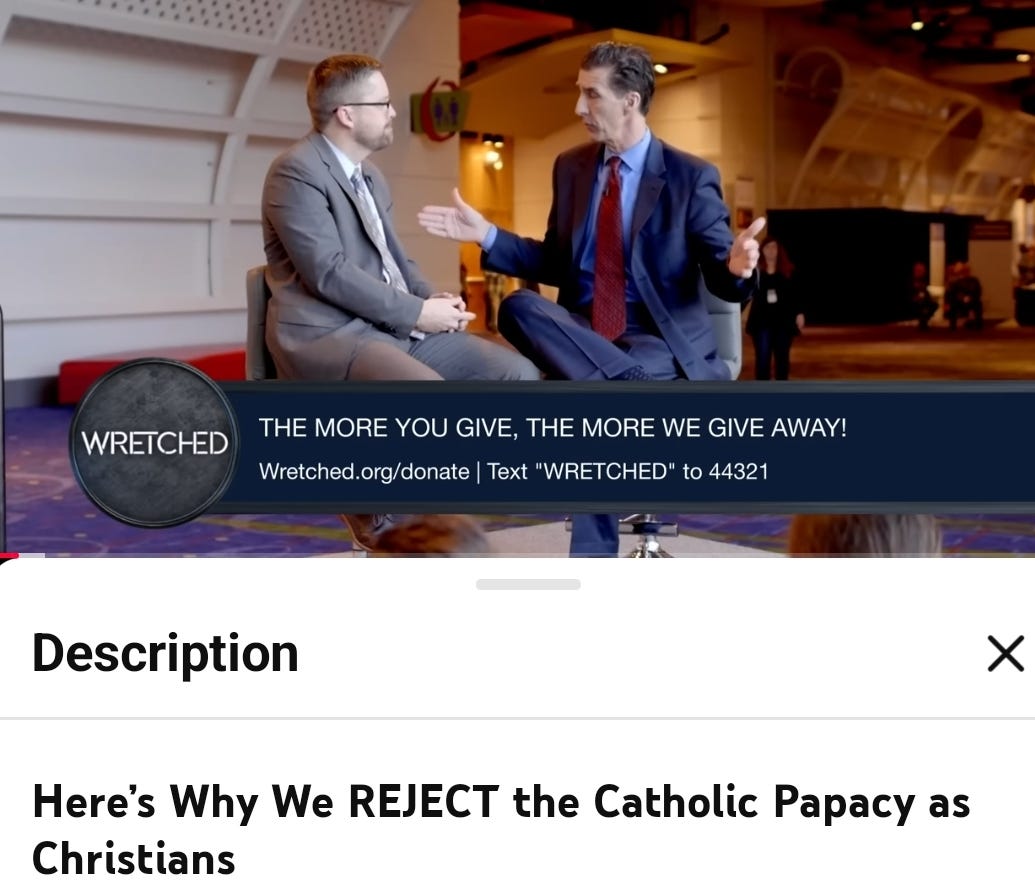
There is rather a lot of this type of evangelical Protestant content on YouTube emerging from the southern states and starting to influence evangelicals across the world. A recent example is Todd Friel’s Wretched video, “This Catholic Apologist Is Using a DEVIOUS Strategy to Lure in Christians.” Friel attacks a Catholic apologist for using selective dialogue and shared language about Jesus, sin and salvation. He leans hard on the Council of Trent’s anathemas against justification by faith alone, the necessity of the sacraments, the Mass as a re-presentation of the sacrifice, the Treasury of Merit and the mediating role of the Church. The clear implication, familiar to anyone who has spent time in certain corners of American evangelicalism, is that the Catholic system is not merely deficient. It sits outside Christianity altogether. Much of Friel’s content seems obsessed with attacking the Pope, Catholicism and individual Catholics. It is a strange way to behave as a Christian and treads a fine line between obsession and outright bigotry. Friel is a great one for attacking Catholics for not knowing Scripture, or at least his interpretation of it, yet he seems a bit rusty on 1 Peter if his own conduct is anything to go by.
Friel is not the only one. John MacArthur has long maintained that Roman Catholicism is a false religion preaching a different gospel, repeatedly labelling its doctrines on justification, the Mass, Mary and the papacy as heresy and placing the entire system outside true Christianity. Mike Gendron, a former Catholic, focuses almost exclusively on this theme, arguing that official Catholic teaching on salvation, authority and the sacraments means faithful Catholics are not Christians at all and must be evangelised as if they were unbelievers. Robert Jeffress has described Catholicism as a counterfeit religion that grew out of pagan Babylonian mystery cults and has linked it to the Whore of Babylon in Revelation. John Hagee has gone further still, identifying the Catholic Church with the Beast of Revelation, blaming it for plunging the world into the Dark Ages, and portraying its historical role in terms of theft, rape and institutionalised violence.
They all share one striking feature: a body of work that appears more preoccupied with railing against popery than with feeding the good news to their own congregations. This focus seems odd when one considers that Catholicism remains a clear minority in the regions most of them serve, and that their hearers rarely encounter it in any sustained way in daily life. There is nothing new in the impulse. My own grandmother was a direct descendant of John Knox’s elder brother; the Presbyterianism her family carried from Scotland into Ireland was steeped in precisely this sort of sustained and often heated opposition.
This is not an isolated outburst. Across large parts of the southern United States, and in the networks that radiate from them, many evangelicals and Baptists still refuse to call Catholics Christians. The refusal is often delivered with the casual certainty of a weather report. Catholics may use the name of Jesus, recite the Creed, baptise in the Trinitarian formula and affirm the bodily resurrection, yet because they do not frame salvation in the precise forensic categories of sixteenth-century Protestant polemic they are placed outside the fold, somewhere adjacent to Mormons or Jehovah’s Witnesses in the taxonomy of error.
I know the cultural soil this grows in. The South and Southwest of the United States were settled in large measure by my people, the Ulster-Scots, the Scots-Irish. We brought our music, our tribalism, our Celtic tempers, our polite manners when it suited us, our courage and stubbornness, and our settled contempt for “Papistry.” That contempt was refined long before the American frontier, in the Plantation of Ulster, in the wars of the three kingdoms and in the long memory of Reformation conflict. When those settlers poured into the Appalachians, the Carolinas, Tennessee, Kentucky and beyond, they carried a religious culture forged in opposition. Presbyterianism gave way in many places to Baptist and later evangelical forms, but the anti-Catholic reflex remained. It became part of the ambient air, reinforced by the relative cultural homogeneity of large rural and small-town stretches of the South, where the nearest Catholic parish might be distant and the local religious landscape consisted of a handful of overlapping Protestant congregations.
Looked at from a distance the constant debate is revealing. Catholics, for the most part, correct the more egregious misrepresentations of their doctrine and still treat evangelicals as fellow brothers and sisters in Christ. The Catholic Church has never ceased to regard validly baptised Protestants as Christians, albeit separated. The courtesy is not always returned. There are those on the evangelical side who will not grant even the basic respect of acknowledging Catholic Christianity. That asymmetry is not sophisticated theology. It is frequently lazy bigotry dressed up as confessional fidelity.
Mature societies, by which I mean societies older than two hundred and fifty years that have spent a good proportion of the last five centuries battering one another over precisely these sectarian questions, have learned a harder lesson. Through millions of deaths, civil wars, penal laws and, in living memory, bombs and guns of terrorism, we discovered that we need to make the effort to rub along together. This is especially true when confronted by aggressive state secular moral relativism on one side and expanding, confident and often hostile forms of Islam on the other. In those older societies the reflex is different. We treat one another with the respect due to fellow believers in the same Christ, even while we continue to argue vigorously about the nature of the Church, the sacraments and justification. The alternative has been tried. It produced rivers of blood and solved nothing permanent.
It is therefore both surprising and disappointing to watch a corner of the world where this reality has yet to sink in. Perhaps it is the consequence of hundreds of miles of the same culture, the same stores, the same schools and the same half-dozen churches of this or congregations of that. When you are not routinely exposed to the demographic and sectarian tensions that forced other parts of Christendom to grow up, it becomes easier to maintain the pure, uncompromising posture of the theological gated community. The result is a certain parochialism, an appearance of being disconnected from the larger realities and threats facing historic Christianity.
The energy spent denying the Christianity of the largest body of believers on earth is strategically self-defeating. Aggressive secularism seeks to reduce the faith to a private hobby and to rewrite the moral grammar of the West. Parallel to it, demographic and cultural shifts driven by large-scale migration from Islamic societies are introducing forms of religious confidence that do not share the post-Enlightenment liberal restraint many Western Christians still take for granted. In that context the spectacle of evangelicals policing the boundaries of the family name while the walls of the house itself are under pressure looks less like vigilance and more like distraction. None of this requires anyone to pretend the Reformation never happened or that the differences over justification, authority and the sacraments are trivial. They are not. Serious Catholics and serious Protestants can and should continue to argue them with precision and charity. What it does require is the basic recognition that the people who confess the same Lord, the same baptism and the same hope of the resurrection are not members of a different religion. They are family, estranged in important ways, sometimes deeply so, but family nonetheless.
The Ulster-Scots temperament that helped settle the American South was never short of courage or conviction. It could usefully rediscover another of its historic capacities: the ability, hard-won through centuries of conflict, to distinguish between a rival within the household of faith and an adversary outside it. Until that distinction is more widely recovered, the online content will continue to circulate, the old reflex will keep firing, and the real threats will keep advancing while we argue about who is allowed to use the family name.
As a Scottish Catholic who grew up in the Faith ,and continues to practice it in my old age ( i'm 79 ) ,i can truthfully say that we were never taught ,either in school or in Church to " hate " protestants or indeed Jews. We were taught tolerance ,love and forgiveness ,and Catholics do not " worship " the Pope. He us Christ's Vicar on Earth ,a successor to St Peter to whom Jesus said " Thou art Peter and upon this rock I will build MY CHURCH and the gates of Hell will never prevail against it. Whstsoever you loose on earth shall be loosed also in Heaven and whatsoever you bind on earth shall be bound also in Heaven ". Mary ( our Lady ) is the mother of Christ and ,by Christ's instruction on the Cross ,is now our mother also. We do not "worship" Mary or the Saints ,we ask them to intercede for us with the Lord !! The Catholic ( ie Universal ) Church was the FIRST Christian Church and it's sad and dangerous to deny this FACT ,thereby continuing to cause division just when the rise of Islam is a danger to the world ,indeed all of humanity. May God protect us all.🙏🙏🙏
I think there can be a lot of going through the motions, and implicit tribalism to boot. While this is common in many institutions, Christians do need to try and avoid it and show a better way.